
What is AND in mathematics? When you learn logic, one of the first concepts you encounter is a conjunction. A conjunction is a statement that joins two other statements (or propositions) together with an “AND” operator.
A conjunction requires both statements to be true. For example, if p and q are individual statements, then “p and q” would be considered true only when both p and q are themselves true. Otherwise, it’s false.
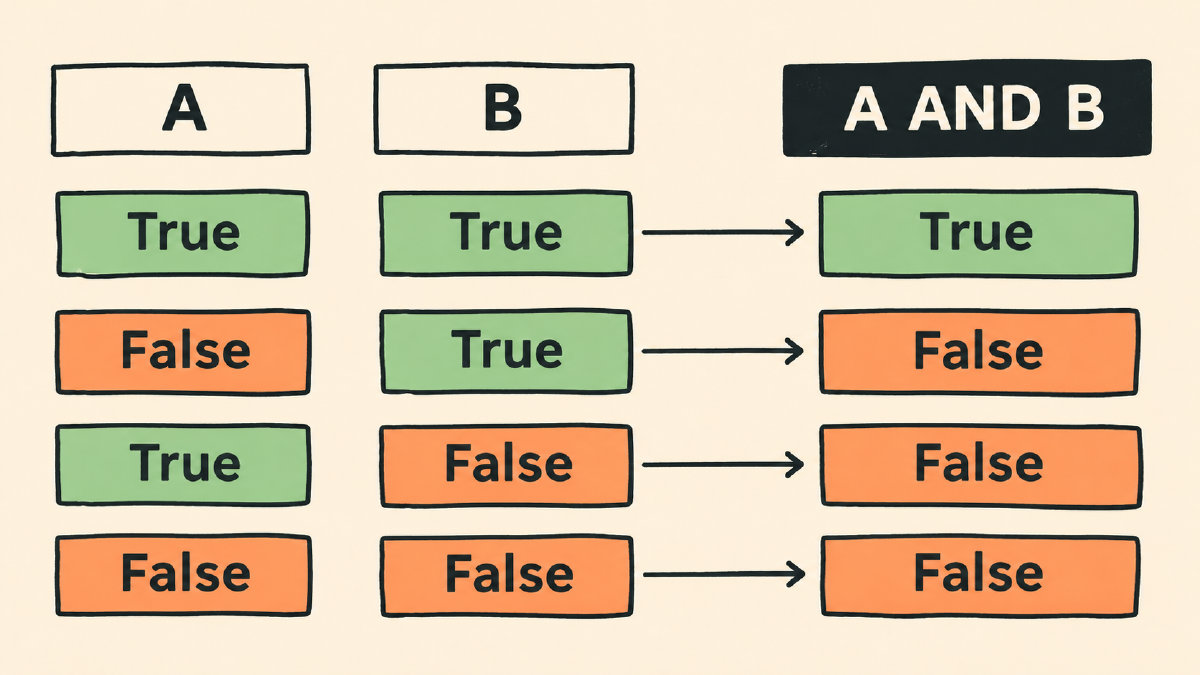
In mathematics, we read this as “p ∧ q” — which can also be rendered in words as “p and q.” As shown in the following truth table, a conjunction is only true when both of its components are true.
There are a few ways to represent logical AND: either by writing the word “and,” or by using the symbol ∧. In LaTeX math mode, for example, $p \wedge q$ will produce p ∧ q.
The ordinary two-valued conjunction
In propositional logic, the simplest case of a conjunction is the ordinary two-valued conjunction — meaning that there are just two values: true and false. Let’s examine how each pair of input values leads to a result:
-
If p = true, q = true, then the conjunction p ∧ q is true.
-
If p = true, q = false, then the conjunction p ∧ q is false.
-
If p = false, q = true, then the conjunction p ∧ q is false.
-
If p = false, q = false, then the conjunction p ∧ q is false.
That’s all of the combinations. One combination yields a true value, while the rest yield false values.
AND and inequalities
How does the AND connect inequalities?
Inequalities can often be combined using the AND connector. But instead of checking whether x is greater than 2 and less than 5, you can combine them into a single inequality: 2 < x < 5. That’s the same as the previous condition.
Let’s check a couple of values:
-
x = 3: This value satisfies both conditions (x > 2 and x < 5), so the entire expression should evaluate to true.
-
x = 1: While x < 5 is true, x > 2 is false. Therefore, the entire expression evaluates to false.
-
x = 6: Here, x < 5 is false, and x > 2 is true. Again, the entire expression evaluates to false.
Over the real numbers, the solution set to x > 2 is (2, ∞), while the solution set to x < 5 is (−∞, 5). The intersection of the two sets contains those values that satisfy both inequalities: (2, 5).
If the two inequalities overlap, then the intersection will have values. But if they don’t overlap, the intersection will be empty. That’s the concept of an intersection — the overlap between two solution sets. It’s important to note that the AND is the connector between the two statements; the operation on sets is the intersection.
The difference between inclusive OR and AND
An inclusive mathematical OR accepts either statement being true. That is, it’s true when either statement is true, or when both are true. Changing the connector from AND to OR alters the qualifying values. For instance, consider what happens to the inequality above if we change the conjunction to an inclusive OR:
x > 2 OR x < 5
We’re now looking for values that qualify under at least one of the conditions. Thus, x = 1 qualifies under the second condition, and x = 6 qualifies under the first condition. Both of those values fail under AND but qualify under OR. In fact, the union of the two solution sets is the new solution set.