
The beta symbol (β) can be found throughout mathematics, statistics and geometry. The symbol is commonly used in simple linear regression to denote an estimated coefficient, or a parameter value, as well as to label angles.
Beta Symbol and Similar Characters
The Unicode character for lowercase beta is U+03B2, or β — Greek Small Letter Beta. This is distinct from the uppercase counterpart, which is Β (U+0392), Greek Capital Letter Beta. In turn, the Latin capital B, B, also looks similar. The symbol ϐ (U+03D0), called “Greek Beta Symbol,” also appears similar. Similarly, ß is the Latin small letter sharp s, sometimes known as Eszett.
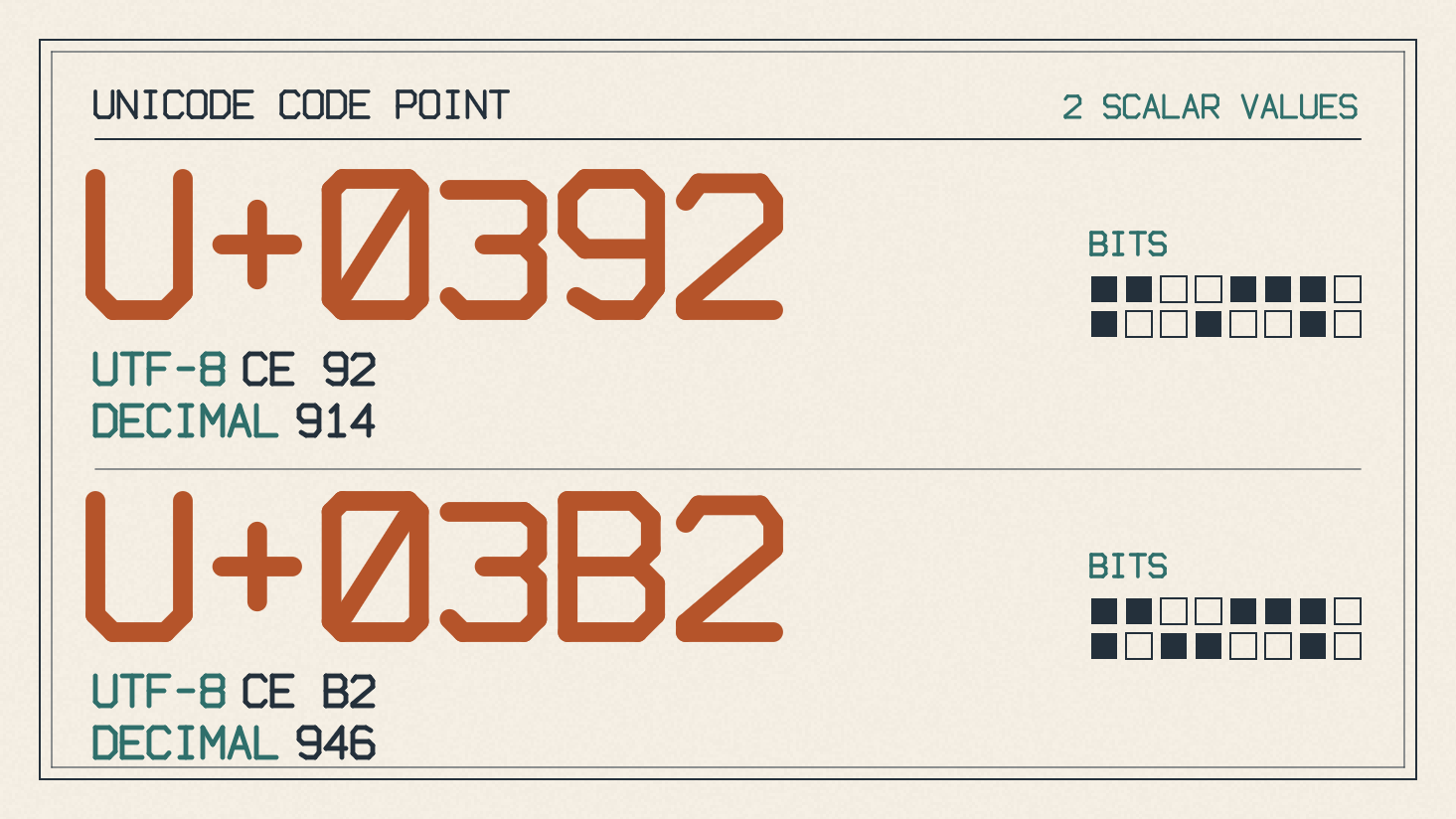
Unicode distinguishes these characters, however, so that when you copy notation involving the symbol it’s possible to preserve the intended character.
Beta in Geometry and Statistics
Beta can also be used to denote different values depending on context. In geometry, beta often denotes a secondary angle. When denoting a triangle, beta is the second angle; alpha is the first angle and gamma is the third angle. If using beta to indicate parameters, such as in a linear regression, then the equation will include a subscript indicating the value of beta, such as the intercept β₀, or the slope β₁. In hypothesis testing, β represents the probability of a type II error, failing to reject a false null hypothesis.
In LaTeX, beta is written with \beta. You can see this below within inline math:
$\beta$
Or using $ and $ delimiters:
$\beta$
Beta with Subscripts
You can use subscripts to distinguish individual βs, including by placing them in groups:
$\beta_0$
$\beta_1$
$\beta_{i+1}$
Beta with a Hat
You can apply a hat to beta, like in regression equations, to represent an estimate:
$\hat{\beta}$