
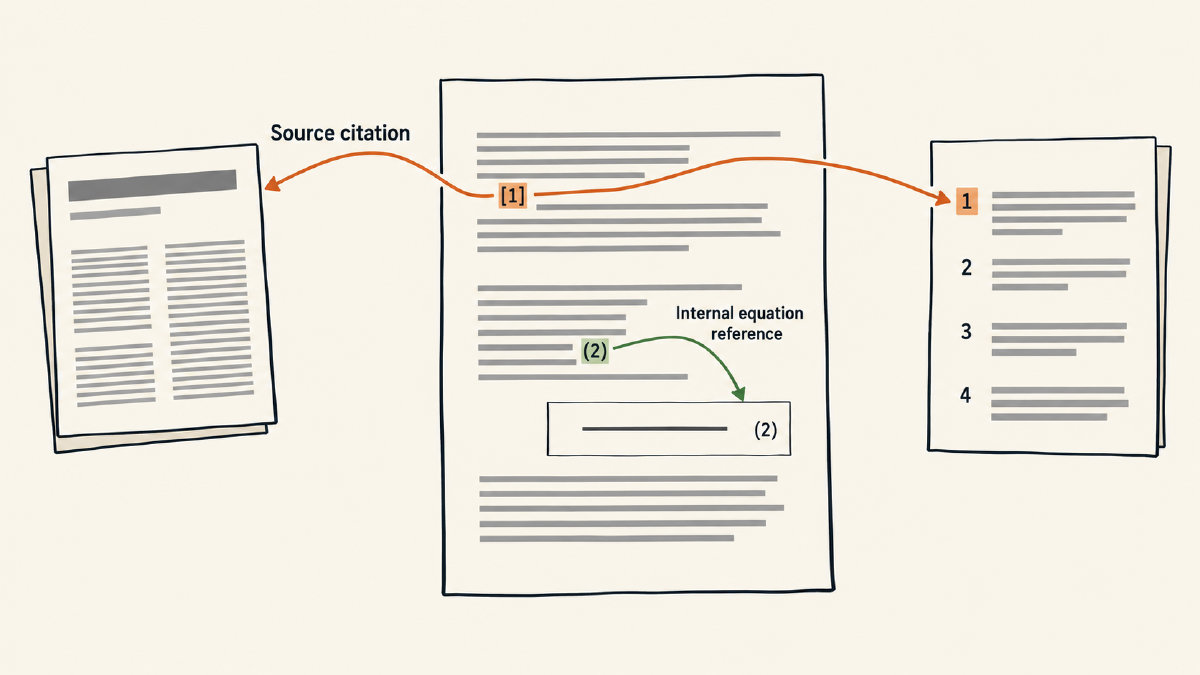
A borrowed equation may need both source attribution and a local cross-reference. The work that you are crediting is not the same as the equation located within your current document. In this case, you will be using IEEE bracketed bibliography numbers (e.g., [1] or [2]) for the sources. You will also be using \cite{key} to indicate the source identification. However, if you’re simply using a local numbering (e.g., equation 3), there’s no source identification.
Where to Place Source Citations
In general, it’s good practice to cite sources immediately after the credited information, or after mentioning an equation in prose. If you are citing an entire paragraph of text, then cite before the punctuation. Use a space before the citation bracket: “Some important property [5].” rather than “Some important property.[5].” Remember, you can use \cite{key} anywhere in the document. Note that in this case, the displayed equation number should appear separately from the source citation. You should place \cite{key} in the surrounding text, outside the displayed equation’s math environment.
To identify a particular equation in another work, remember that the work itself is identified by its source locator, which may include a specific page, figure, or equation number. In other words, the source locator contains two numbers: one identifying the bibliography entry, and the second the equation number. For example, you would say [5, eq. (14)]. Here, 5 represents the bibliography entry, while 14 is the equation number inside that work. A full reference for the containing work, such as a journal article, book, or thesis, must still be included.
When writing an equation in another source, it’s important to preserve the distinction between the equation’s source location and the equation number assigned by your own LaTeX document. In this case, you’ll want to write [5, eq. (14)] to indicate that the referenced equation comes from the fifth bibliography entry, and that the equation has been numbered 14 within that work.
Source Attribution and Local Cross References
Here’s an illustrative example of how this works: The illustrative bibliography key is key. The source locator illustration is [5, eq. (14)]. In this example, we’re attributing the equation with the \cite{key} command, and including the display equation using the \begin{equation} ... \end{equation} environment. The illustrative expression is \sum_{i=0}^{\infty} a_i x^i. Within the equation environment, we’ve added the \label{eq:borrowed} command. Finally, in the text following the equation, we’ve used Equation (\ref{eq:borrowed}) to refer back to the labeled equation. In this case, the local equation number is assigned by LaTeX, and appears in parentheses.
One point to note about compilation requirements is that resolving the local cross-reference is separate from the BibTeX bibliography processing that’s necessary to compile your final document. In Overleaf, where everything is automated, this doesn’t matter — but if you’re compiling a local LaTeX distribution, then you have to perform two compilations to allow LaTeX to resolve all of the references. As an alternative, you can automate the whole process using latexmk, which automatically performs the steps needed to convert main.tex into main.pdf.
The basic workflow using BibTeX involves performing a single LaTeX run to generate a .aux file, then running BibTeX to process the citations, and then performing LaTeX runs again until no changes occur. With the default settings, LaTeX processes equations in the equation environment. In contrast, Overleaf will handle the bibliography automatically for you, allowing you to focus on the content. When working with equations, however, you must ensure that you provide the correct citations and references.
As always, please make sure that you provide the appropriate source attribution when you borrow an equation. Otherwise, you could inadvertently steal someone else’s idea.