
Math “Where” Symbol: What to Use Instead in LaTeX
LaTeX provides no universal standalone symbol that represents the English word “where,” so when using math symbols, it’s best to use the word itself. A related shorthand you may see is the reverse-element-of notation (∋), also known as \ni, but it abbreviates “such that,” not a general “where.”
Equations and math delimiters
LaTeX has some special-case syntax for equations and mathematical expressions, such as inline math inside a sentence versus a displayed equation followed by an ordinary-text where line. But you should keep every English word outside of math delimiters, too. For example, write $f(x)=x^2$, where $x>0$ inline in the paragraph, or display it separately:
\begin{equation*}
  f(x) = x^2,
  \qquad \text{where } x > 0.
\end{equation*}
Inline math belongs in the paragraph, while display math is set separately, and “where” stays outside the math delimiters.
Set-builder separators
The vertical bar and colon are both used to separate parts of a set-builder expression: {x | P(x)} or {x : P(x)}. In each case, these characters represent the phrase “such that.” However, they’re not meant to be generic replacements for “where” after an ordinary equation.
The ∋ character, which LaTeX renders as \ni or \owns, has two meanings: one that abbreviates “such that” and another meaning that simply denotes membership. While this might appear as though there’s an established convention that abbreviates “such that” with ∋, it’s important to remember that the reverse element-of notation means exactly what it says: that something contains as an element.
Informal such that abbreviation
You might also encounter “s.t.” as an abbreviation for “such that” in constrained optimization problems, informal prose, or existence statements. But again, it’s more of a shorthand than a replacement for where-clauses.
Sometimes you’ll need a trailing where-clause for a function definition. But other times, a formalized cases environment will be better suited to the task. In that environment, each branch gets its own row, paired with its condition. With amsmath, use & between a value and its condition:
\begin{cases}
  x, & x \ge 0,\\
  -x, & x < 0.
\end{cases}
A comma after the value is a common alternative to spelling out “if.”
Formal notation for conditions
There are some conditions that do belong inside formal notation. For example, comma-separated conditions that apply simultaneously, or precise quantifiers (like ∀ for “for all” or ∃ for “there exists”). However, you shouldn’t confuse these with simple conditions that just help define the variables at hand; instead, place them inside their own parentheses and ensure your set-builder separators are tied directly to their respective predicates.
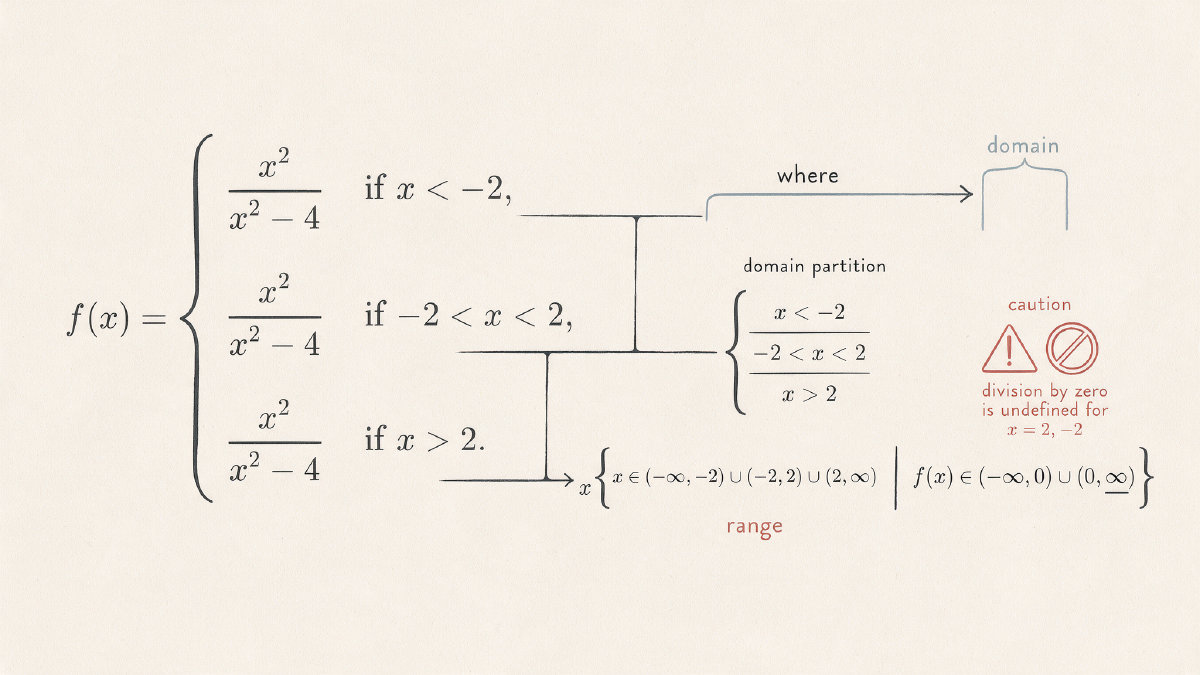
A good rule of thumb is to use prose (“where”) when defining the parameters to your function, or any other kind of expression for that matter. If your conditions are truly part of a formal mathematical notation, then it makes sense to use either a vertical bar (\mid) or a colon (:) inside a set builder. When defining branches of functions, the cases environment is ideal. Finally, don’t be afraid to use a formal quantifier like ∀ (or its equivalent \forall) or ∃ (and \exists) when describing the exact condition of your problem — just don’t let it become an informal explanation.
When in doubt, go with the simplest approach: prose for definitions, \mid or colon inside a set builder, and cases for branches.
References
What’s This “S.T.” Meaning?
What Are Set Notations?