
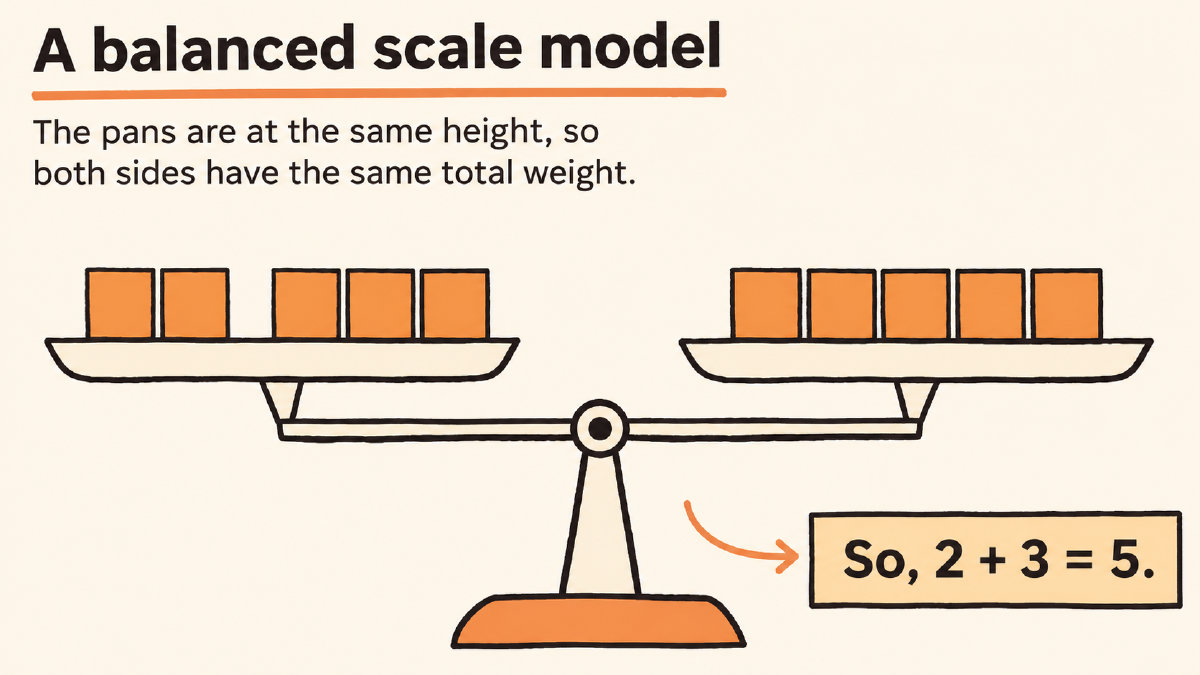
Mathematical equation meaning comes down to equality: in mathematics, this means a relationship between two expressions, which can be identified as each side. A simple example is 2 + 3 = 5, where the left-hand side (2 + 3) and the right-hand side (5) are said to be equal. The equals sign (=) signifies that both sides have an equal value.
Expressions and Equations
An expression may be evaluated at a given variable value, while an equation asserts equality between two expressions. For example, evaluating 3x + 5 at x=3 gives us 14. Alternatively, we might assert that 3x + 5 = 14; solving this equation requires finding a value of x that makes the assertion true. In this case, substituting x=3 into the expression shows that 3(3) + 5 does indeed equal 14. Any other real value of x would make the assertion false.
There are three types of equations: identities, conditional equations, and contradictions. An identity holds for all values of its variable, such as x + 0 = x, which is true for every real number. A contradiction, like x + 1 = x, has no solution within the domain of real numbers. Whether a particular equation is true or false depends on the nature of the equation itself and its domain.
Typing a Basic Equation
When typing a basic equation, it's important to preserve both expressions and their equality. You can use inline math delimiters to enclose mathematical expressions, such as $3x + 5 = 14$ in LaTeX. Microsoft Word on Windows includes a variety of equation-editor entry points, including Insert > Equation. On a keyboard, you can simply type Alt+= to insert an equation editor box.