
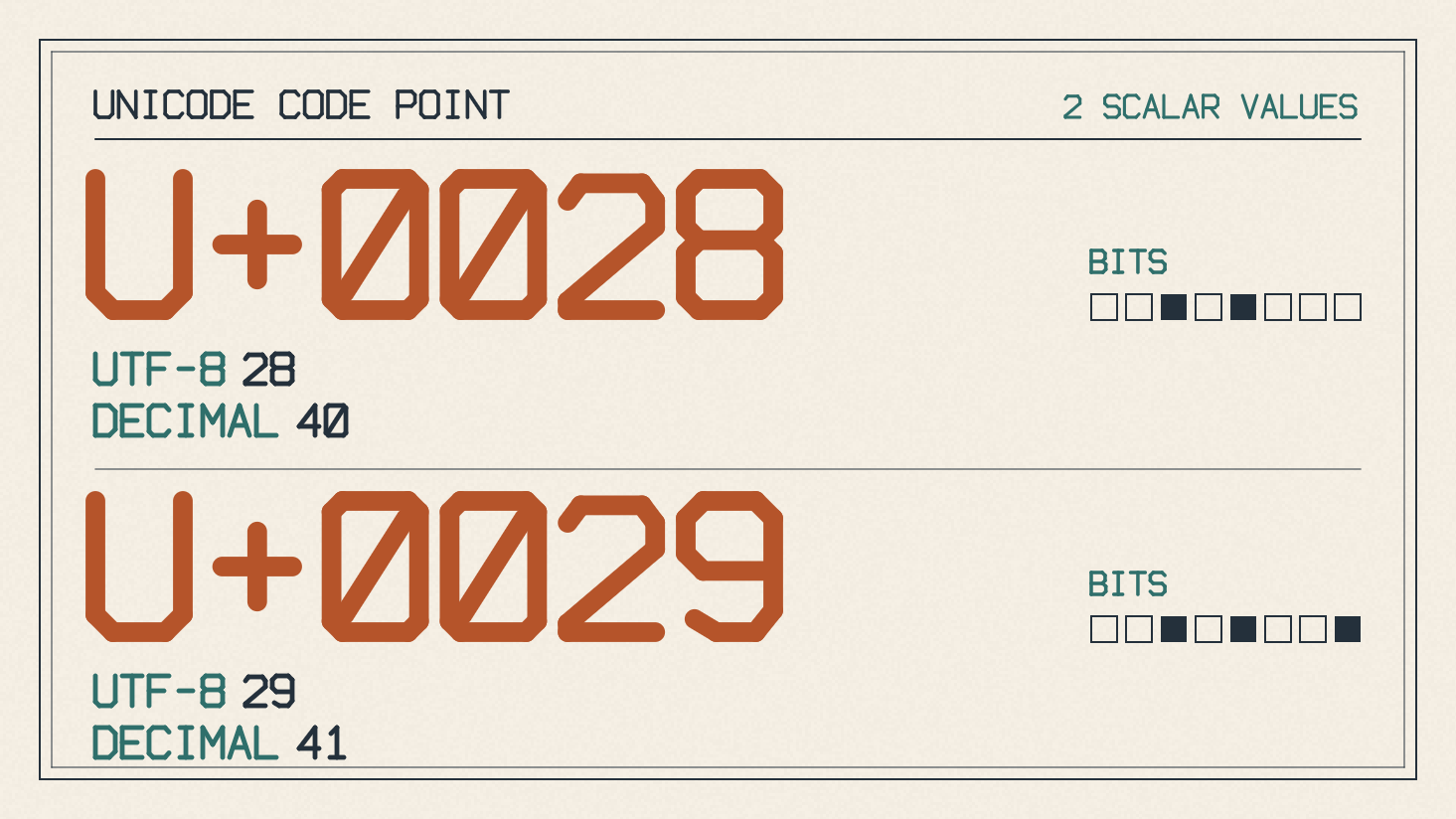
The ordinary parentheses symbol, as seen in ((x)), is available to copy individually or as a pair. The left parenthesis opens an expression in mathematical notation, while the right parenthesis closes it, with each character encoded separately (U+0028 LEFT PARENTHESIS for the opening and U+0029 RIGHT PARENTHESIS for the closing). Fullwidth parentheses, like ( ), represent separate characters (U+FF08 FULLWIDTH LEFT PARENTHESIS and U+FF09 FULLWIDTH RIGHT PARENTHESIS) that can appear different depending on the context.
Parentheses in Math
Parentheses, square brackets, and braces serve distinct roles in math: parentheses group subexpressions and override usual order of operations (2 × (3 + 4) groups addition before multiplication), square brackets define intervals and sets, and braces denote sets by listing elements. (a,b] excludes a and includes b; braces enclose defining rules too. In LaTeX, parentheses around a tall fraction are sized automatically when written with \left( and \right); otherwise, parentheses are used directly in math mode. For example, (x) or \left(\frac{a}{b}\right).
Copy parentheses, open a new document, then paste them into the appropriate place. For example, typing “( )” will create one set of parentheses. To insert a fullwidth parenthesis, copy ( or ) and paste it into the appropriate place.