
In subscript mathematics, a subscript, also called a subscript index, is an indicator below the normal line after a symbol. This can occur with subscripts that identify the position or value of an indexed item.
The placement of the subscript determines its meaning, as does the spoken reading of a subscript when used within an expression. But what it means may depend upon the surrounding context — if any — which defines the meaning of the item being referenced.
A sequence, for example, can be defined by an expression (or formula) which describes the domain of a variable, such as integers. It is then possible to reference the term of the sequence using its position, identified by an index.
A matrix is a two-dimensional grid of elements arranged in rows and columns. A matrix entry can be uniquely identified by its row and column indices, so that it’s possible to find exactly where the element appears within the matrix.
In some contexts, it’s necessary to label items in a sequence or matrix as something else, like the maximum or efficiency. In these cases, the label should be upright, unlike italic variables.
Subscripts identify indexed items, while superscripts can represent exponents, so it’s important to distinguish their positions. The rules about subscripts and superscripts still apply when transcribing a mathematical expression into text format, however.
There’s nothing difficult here; the challenge is in knowing how to use subscripts in a way that preserves their meaning. Fortunately, the LaTeX syntax needed to do this is simple enough that it takes only a few keystrokes. For a detailed description of how to do this, read on.
The placement and spoken reading of a subscript
You might hear the following phrase: “x sub i” when someone reads the symbol xᵢ out loud. That pronunciation makes sense because the word “sub” is short for the word “subscript.”
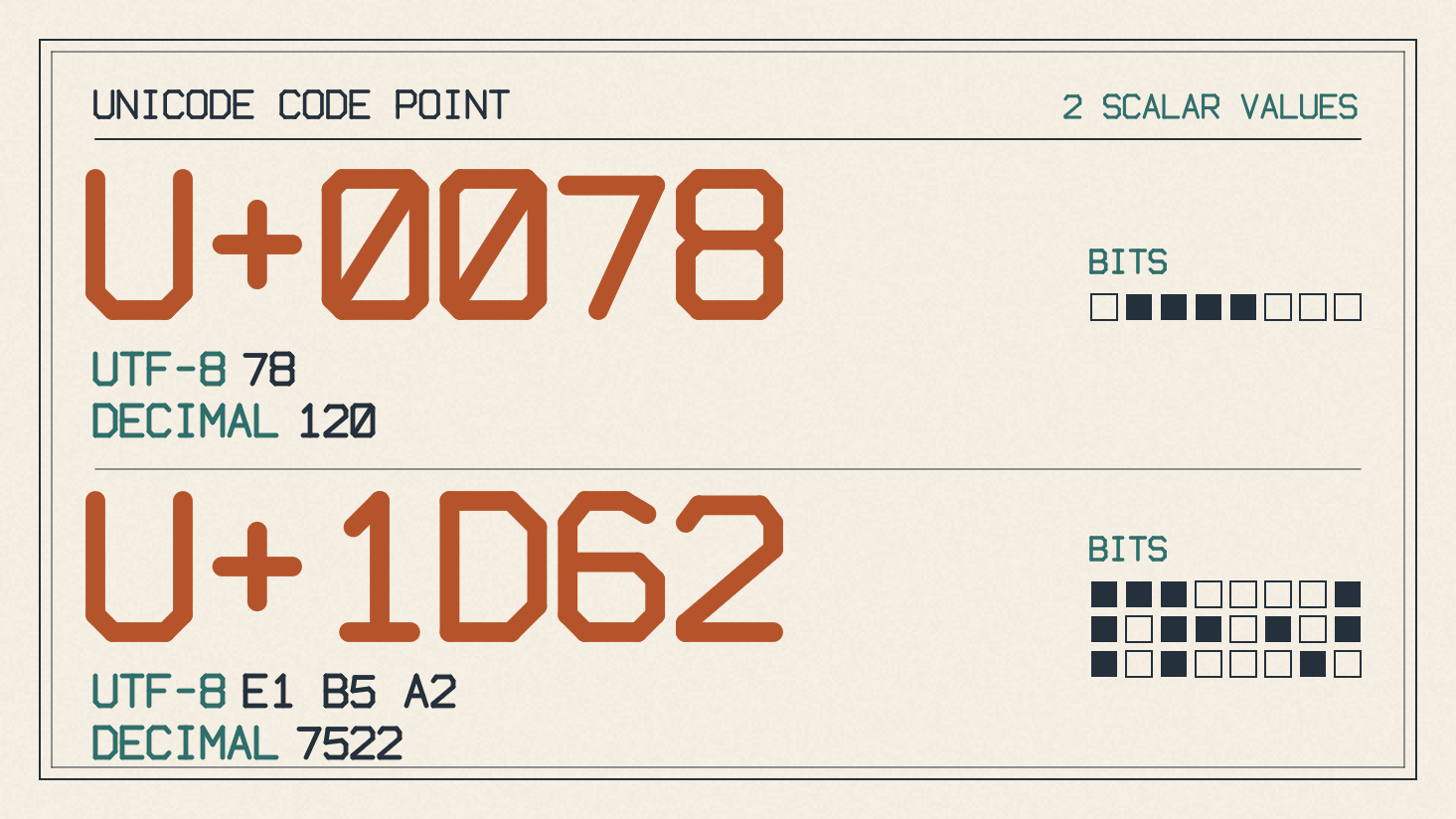
But don’t confuse the pronunciation of the subscript with what the subscript means. The subscript i doesn’t mean that the quantity i identifies the item; rather, it identifies the position of the item. If you were told to compute x₂, then that would mean finding the value of the term with index 2. If indexing starts at 1, that’s the second item; if it starts at 0, that’s the third.
This distinction is important, because when you’re working with sequences and matrices, you will typically work with terms instead of values.
If a sequence is defined to begin counting from one, then a₀ isn’t the first term in that sequence, because it starts counting at zero. However, if the sequence is defined to begin at 0, then a₀ would be the first term.
It is important to remember that, unless otherwise noted, an index is always an integer, and that the index identifies the position of the term within the sequence.
So, the subscript identifies the term of the sequence, and the value of the term depends on the definition of the sequence.
For example, the value of the first term in a sequence could be 1, but the first term itself could be named x₁. In this case, we’d say that the sequence has an initial term of 1, and that the name of the term was x. We’d refer to the first term as x₁, which means that the subscript identifies the term’s position within the sequence.
Sequences
We can define sequences using different indexing methods. One method is to assign each element a numerical index, which identifies its position in the sequence.
Let’s consider an arbitrary sequence: a₁, a₂, a₃,… an.
In this example, the index n indicates the position of a particular element in the sequence. The starting index can either be 1 or 0. If the sequence is defined to begin at 1, then a₀ is the term before the first term, and is not included in the sequence. However, if the sequence is defined to begin at 0, then a₀ is the first term in the sequence.
When identifying an individual element in a sequence, the index of the element indicates its position in the sequence. For example, a₂ represents the second element in the sequence, while x₂ refers to the second element in a sequence whose elements are labeled x₁ through xn.
The index identifies the ordinal position of the term within the sequence, but the actual value of the term depends on how the sequence is defined. So, if a sequence is defined as the set of numbers {2n | n ∈ ℕ}, then the value of the second term is 4, and the third term is 6.
Matrix entries
An entry in a matrix can be uniquely identified by its row and column. As matrices are arrays of elements arranged in rows and columns, we must be able to identify the specific element that resides in the row-column intersection.
We achieve this identification via two indices: the row index, which identifies the row of the element within the matrix, and the column index, which identifies the column of the element within the matrix.
For example, a_{2,3} identifies the entry in row 2, column 3 of a matrix whose entries are labeled a. Using this information, we can locate the element within the matrix, and access the value stored there.
Because the row and column indices identify separate attributes of the same matrix entry, it is useful to place punctuation between them to ensure that their meanings remain distinct. This punctuation can be either a comma, a period, or simply the lack of any punctuation. If unseparated indices could be misread, a comma helps keep the notation clear.
Descriptive subscripts
At times, we may want to label an item with something more than just an index. In these instances, the label should indicate what kind of item is being referenced, such as a maximum, minimum, or efficiency.
Typically, labels written next to an expression are upright, which means that the characters are not slanted like regular variables. Descriptive labels in subscripts are also written upright, while variables are generally italicized.
For example, in $x_{\text{max}}$ and $x_{\text{eff}}$, the labels max and eff are upright, unlike the variable x. Both labels serve as descriptive subscripts.
In many mathematical typesetting programs, such as LaTeX, variables are automatically displayed in an italic style by default. This means that the letter m will appear slanted. To display the label “max” as an upright character, we can enclose it inside the \text{} command. The amsmath package provides \text{}; we can also use \mathrm{}, which is available in standard LaTeX math mode.
Indexed items vs. exponents
Subscripts identify indexed items, while superscripts can represent exponents. For example, x₂ represents the second item in a sequence indexed from 1, whereas x² represents the square of the quantity x. When we write an expression that uses both subscripts and exponents, such as x_i^2, the subscript i identifies the item xᵢ, which is the base, and the superscript 2 is the exponent.
In the equation shown here, we see both a subscript and an exponent. In the expression x₂, we’re talking about an indexed item, with a subscript of 2. In the expression x², we’re talking about the square of x. When we combine the two, as in the expression x_i^2, we have to determine which part of the expression applies to which. Here, the subscript i identifies the item, and the exponent of 2 supplies its exponent.
Transcribing a math expression
If you need to transcribe an equation that includes both a subscript and an exponent, you’ll need to preserve both. This involves using the correct symbols to indicate both, which are:
Underscore (_) for subscripts
Caret (^) for superscripts
Each marker takes only the next character as a script, which means that it’s easy to mix up subscripts and superscripts when you are transcribing an equation. Braces ({}) allow you to group scripts longer than one character, such as an entire expression.
For example, $x_2$ produces the expression x₂, with a subscript of 2.
The expression $a_{n+1}$ is also generated with the underscore character, as well as the expression $a_{i,j}$, which contains two subscripts separated by a comma.
Finally, the expression $x_i^2$ contains both a subscript and a superscript.