
In mathematical typography, angular brackets refer to a paired bracket-shaped mark. They are also called angle brackets, but it's best to distinguish between the ordinary plain-text use and their proper typeset usage.
Angular brackets and Unicode
Angular brackets (also known as chevrons) have several names and Unicode representations, including ASCII less-than and greater-than signs. ASCII < and > are used to represent inequalities and are widely substituted for brackets in programming languages; the typographic symbols ⟨ and ⟩ are the mathematical angle brackets. However, for mathematics, you should never use raw ASCII characters as delimiters; instead, choose commands that match their typographic role. Use < and > only when they genuinely require ASCII syntax or are used within the text body of your document.
LaTeX math-mode has two commands for creating pairs of opening and closing left and right angle brackets: \langle and \rangle, which are equivalent to the Unicode U+27E8 MATHEMATICAL LEFT ANGLE BRACKET and U+27E9 MATHEMATICAL RIGHT ANGLE BRACKET. You can also use these same commands if you're working with legacy systems that do not yet support newer Unicode standards. There are also older Unicode code points, namely U+2329 and U+232A (U+2329 MATHEMATICAL LEFT ANGLE BRACKET and U+232A MATHEMATICAL RIGHT ANGLE BRACKET), but they should be deprecated for Western mathematical text.
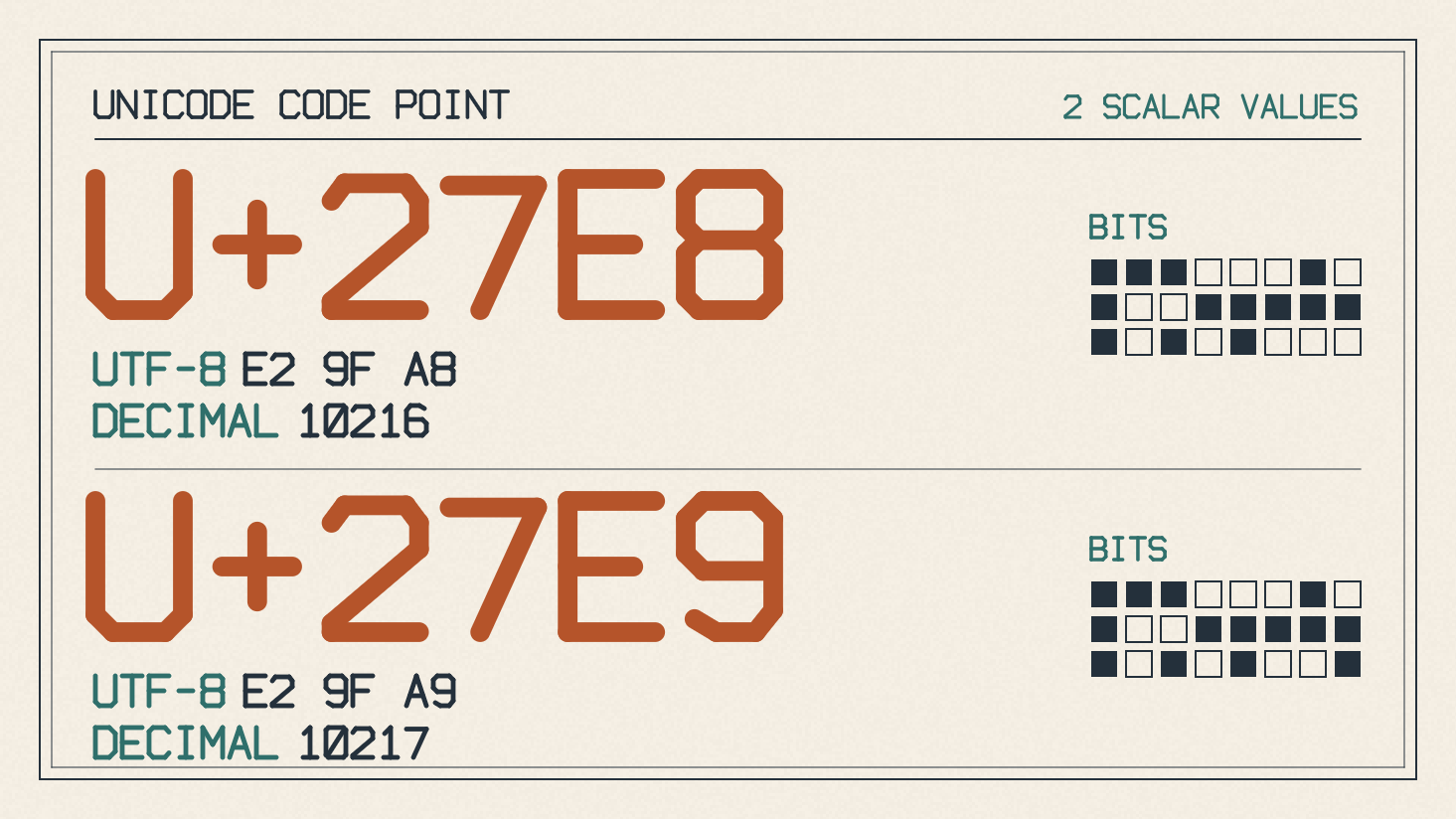
Basic angle bracket syntax
Here is the basic LaTeX math-mode pattern using paired opening and closing commands, shown here with a simple expression instead of the raw comparison signs:
$$\langle x+y\rangle$$
Automatic and explicit sizing
You can automatically size the delimiter for an expression depending on its height, such as for fractions or tall expressions. LaTeX will attempt to automatically match the height of the delimiter to the height of the inner expression by using stretchable delimiter commands. This can be useful for tall expressions; the example below instead shows the explicit alternative. If necessary, you can make one side invisible with \left. or \right., while using \left\langle and \right\rangle to specify matching angle-bracket pairs. The command \left specifies that you want to begin a pair of stretchable delimiters, while \right tells TeX where to close them. You’ll always need both.
$$\left\langle \frac{a}{b} \right\rangle$$
$$\Biggl\langle 3x+7\biggr\rangle$$
The above example demonstrates how to control the size of delimiters explicitly when required. Here, we’ve manually set the size with \Biggl and \biggr rather than relying on automatic sizing.
Common mathematical notations
The same LaTeX pieces can be combined in various ways to represent common notations in mathematics. An average or expected value can be written as $$\langle x\rangle \quad\text{or}\quad \mathbb{E}[X]=\langle X\rangle,$$ an ensemble average follows the same pattern, and an inner product looks like $$\langle a,b\rangle.$$ In Dirac bra–ket notation, you may write $$\langle a|b\rangle$$ or, with an operator $\hat{O}$, $$\langle a|\hat{O}|b\rangle.$$
As with many other elements of LaTeX, the key practical rule is to choose the appropriate command or Unicode math symbol based on its typographic role. Use the raw < and > only when they genuinely require ASCII syntax or are used within the text body of your document.