
The Greek letter sigma (Σ; σ; ς) is the 18th Greek letter. But it can have different forms in math, text, or Unicode.
When you need to type a mathematical symbol like the summation operator (∑), lowercase sigma (σ), uppercase sigma (Σ), or final Greek lowercase sigma (ς), you might be unsure how they differ. And that’s not unusual. The Unicode standard splits visually similar characters into different code points for distinct meanings, whether you’re copying from a PDF, typing in Word or Google Docs, or just using an equation editor. Here’s a guide.
What does the Greek letter Sigma look like?
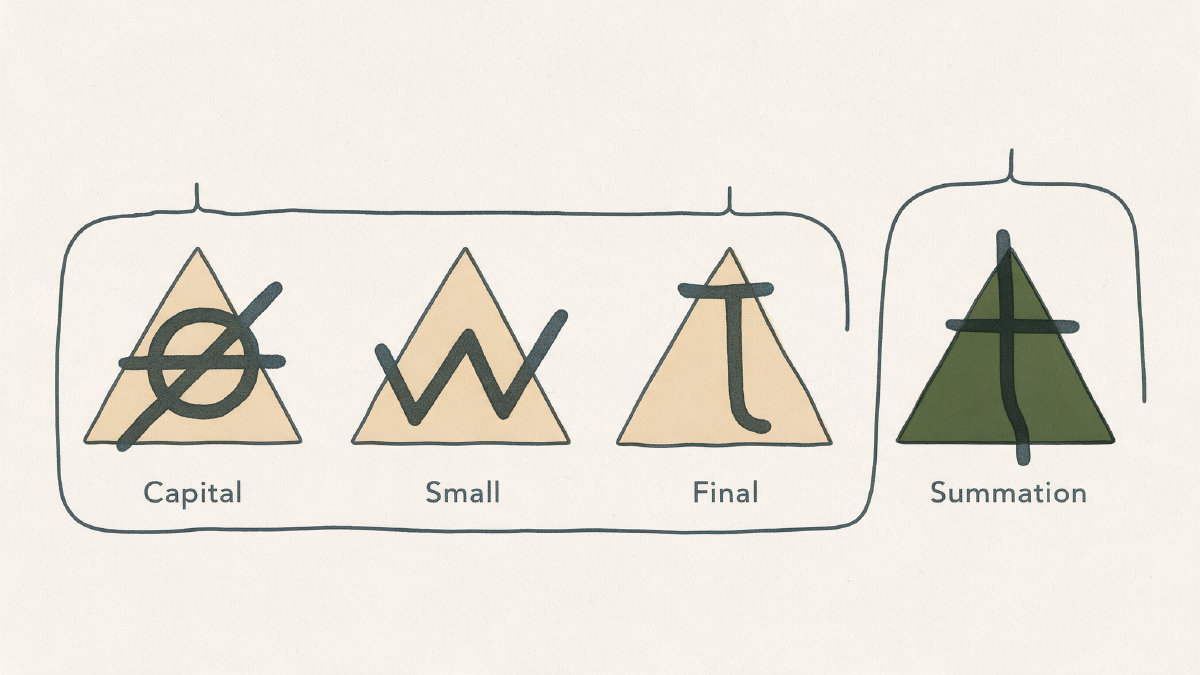
There are three basic forms you’ll normally use for the Greek letter sigma: a capital sigma (uppercase), lowercase sigma, and the final sigma (also known as the orthographic or word-final lowercase Greek). In other words, the Unicode Standard defines three different code points to represent what may appear to be the same glyph.
In Greek, the uppercase sigma looks like this: Σ. The lowercase sigma is written as σ. However, when writing in Greek, sometimes the last letter is written as the Greek letter “final sigma,” ς. It should be noted that the final form is used as an orthographic rule when sigma comes at the end of a word.
In the context of math, we see the lowercase sigma, σ, used to represent the population standard deviation, and the summation notation, which uses the separate n-ary summation operator, ∑. As we’ll see below, these symbols are visually similar, but they have different meanings and code points.
Unicode has split these Greek letters, but the visual difference between them isn’t obvious. For example, here are the four different code points:
U+03A3 – Greek capital letter sigma
U+03C3 – Greek small letter sigma
U+03C2 – Greek small letter final sigma
U+2211 – n-ary summation
So how does the Unicode Standard decide how each symbol is interpreted? In some cases, it comes down to the code point. When you copy formulas or expressions with special Greek symbols, the font will render them accordingly. You might not always see that the correct glyphs have been chosen, but if you know what to look for, then you can verify.
Summation Operator Meaning
In mathematics, the summation operator is used extensively in describing sequences and series. The notation includes the summation operator (∑), a lower index (the start of the sequence), an upper stopping value, and the term to the right of the summation operator. The large sum operator is actually a stylized version of the Greek letter Σ. This makes sense because the sum represents the total of the terms; the Latin letter S also derives from sigma. Thus, the summation operator is also called the sigma operator.
How do I type a Greek sigma symbol?
Lowercase Sigma in Statistics
Lowercase sigma (σ) means something specific in statistics: it refers to the population standard deviation, which is a measure of the spread of values around the mean in a probability distribution. The population standard deviation formula divides by N, the number of data points in the population. If you want to compute the sample standard deviation, you divide by N − 1 instead. The N − 1 divisor makes the sample variance unbiased, and it results in a larger sample standard deviation than dividing by N. A sample standard deviation is often denoted with a lowercase s. The population mean, on the other hand, is typically denoted by μ.
But lowercase sigma can also refer to other scientific contexts. In general chemistry, σ bonds describe covalent bonds formed by overlapping orbitals between two atoms. The lowercase sigma can also refer to stress (a force per unit area) and conductivity. Surface charge density is sometimes described with a lowercase sigma. In physics, σ can be used to represent cross section or surface charge density. Finally, the symbol may refer to the surface mass density or surface charge density in engineering.
If you’re using the lowercase sigma in your document, don’t worry about confusing it with the lowercase Greek letter. Unless otherwise specified, you’ll use a standard Greek lowercase σ. However, in some instances, the intentional use of a word-final sigma occurs. For example, the Greek word for “king” is βασιλεύς. When you write it in Greek, it’s spelled βασιλεύς. When writing it out in text, you’ll see the word-final Greek letter ς, not the ordinary lowercase σ: βασιλεύς. However, you might notice that it appears as a separate Greek letter — ς — rather than the usual lowercase σ.
Typing in LaTeX Word and Google Docs
Using LaTeX, there are four relevant commands: \Sigma (for a capitalized Greek letter), \sigma (for an ordinary lowercase letter), \varsigma (which denotes the intentional final form), and \sum (for the n-ary summation operator).
In Word, press Alt + = to start an equation, then use Math AutoCorrect or LaTeX-style names such as \sigma, \varsigma, \Sigma, or \sum followed by Space. You can choose UnicodeMath or LaTeX input from the Equations tab if you want to control the format.
Google Docs offers a menu option under Insert > Symbols > Equation to insert equations. The options include a menu for Greek letters. When inserting an equation, you can enter the backslash followed by the name of the symbol, such as \sigma + Space or \sum + Space.
If you’re copying from a PDF, you can check for the appropriate Unicode characters. Look for U+03A3 (Greek capital letter sigma), U+03C3 (Greek small letter sigma), U+03C2 (Greek small letter final sigma), and U+2211 (n-ary summation). Sometimes, the fonts used in a PDF might not properly display the appropriate glyph, so you’ll need to check the meaning based on the surrounding context.