
When you encounter vector math notation, the first question is: What are we naming? In a mathematical text, vectors can be named with an arrow on top of the letter, such as \vec{v}, or in boldface, such as \mathbf{v}. The plain italicized v, however, requires definition and context.
The remainder of this article assumes that we are dealing with real Cartesian vectors. That means that we will assume the standard basis for our vectors: î (x-axis), ĵ (y-axis) and k̂ (z-axis). And since I’m going to discuss two- and three-dimensional vectors, I will make these assumptions for now: that all of the vectors we’re looking at use the same coordinate system and have their components in the same order.
Ordered Components
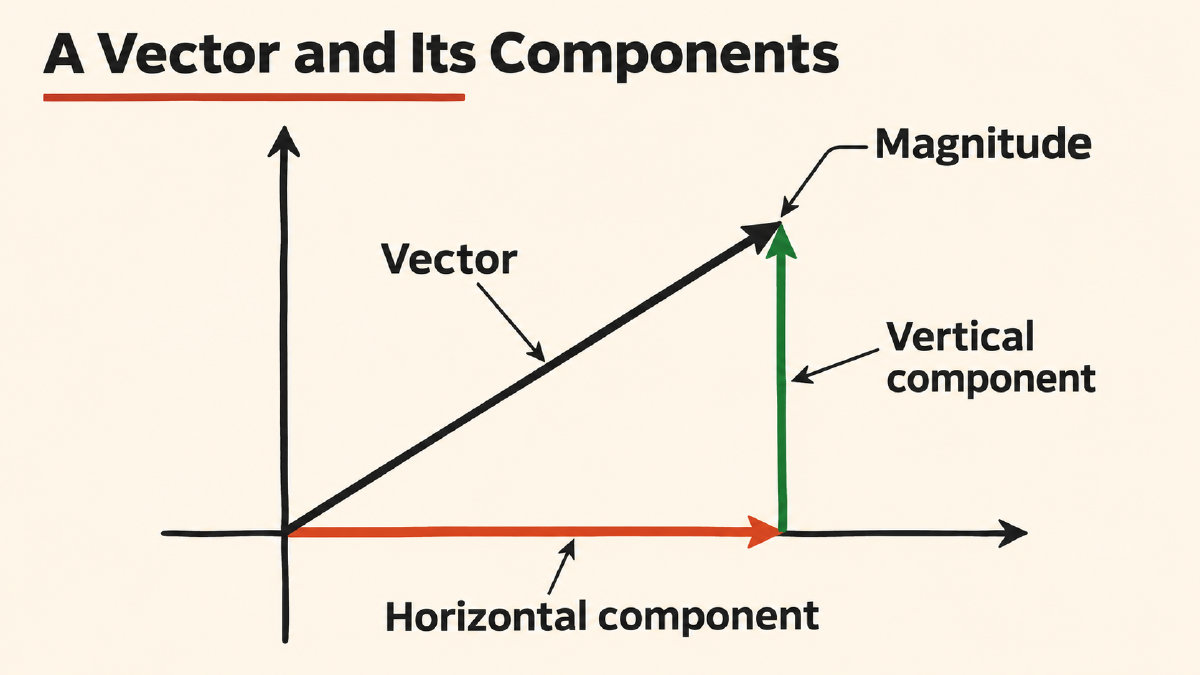
What’s a vector? A vector describes a change from one point to another. However, the location of that vector within the coordinate system isn’t relevant — only its direction and magnitude. So if we define a standard-position vector, then it is simply the displacement from the origin (the tail of the vector) to some terminal point. The vector is described by its components; which also happen to match the coordinates of the terminal-point.
If that doesn’t make sense, let’s look at the more general case. In mathematics, a vector is defined as an ordered set of scalars that describe the displacement of a point in a given space. In the 2D plane, for example, the vector ⟨3, −1⟩ describes the displacement from a reference point (say, (0,0)) to the point (3,−1). It can also describe the displacement from any other point, say (a,b), to the point (a + 3, b − 1).
However, the convention surrounding what kind of brackets or parentheses we use to enclose the components is not important — just like how the choice of coordinate system is unimportant. In many cases, parentheses are used to denote the vector: ⟨3, −1, 2⟩ becomes (3, −1, 2). Some authors prefer angle brackets for vectors, using parentheses for points. The point, as you might expect, is where we find the object in space. The standard-position vector is when the tail of the vector lies at the origin. The components of the vector match the x, y and z (or x, y, z) coordinates of the terminal point of the vector.
A vector can also be considered as an ordered tuple of numbers, with the component order being determined by the chosen coordinate system. If you don’t specify a particular coordinate system, then the components are typically listed in the order of the standard Cartesian coordinate system. You’ll occasionally see the individual components specified explicitly as well: ⟨3, −1, 2⟩ can be written as (3, −1, 2), and also as 3î − ĵ + 2k̂. In each case, the components describe the vector in terms of the basis unit vectors (i.e., the axes) of the coordinate system.
In the equation above, you’ll notice that the components themselves are scalars, which can be positive, negative or zero. The absolute value of a scalar component, however, represents the magnitude of the component vector along that axis.
Vector Magnitude and Direction
Now, there is a distinction between a vector’s magnitude and its direction. The magnitude of a vector is its scalar length. For a standard vector with three-dimensional Cartesian components (such as ⟨3, −1, 2⟩), its magnitude is calculated as follows:
$$\lVert \vec{v} \rVert = \sqrt{v_1^2 + v_2^2 + v_3^2}$$
This magnitude is equivalent to the distance from the origin to the vector’s terminal point.
Note, however, that a nonzero vector has a defined direction. The zero vector (which is a vector with all of its components equal to zero) is an exception. It has no defined direction, though the direction of the zero vector can be assigned by convention if necessary.
The hat
So far, we’ve looked at the components of a vector in relation to the coordinate system, and the scalar quantities of the components. But what if we wanted to determine the direction of a vector?
To determine the direction, we need to normalize the vector. That means dividing each component by the magnitude of the vector itself. When normalized, the resulting vector is referred to as the unit vector of the original vector. Note that a normalization is always done on a nonzero vector, because the zero vector cannot be normalized.
There is another convention, which involves placing a “hat” over the vector, denoted by a caret (^). This is usually reserved for a unit vector. Again, you’ll note that the standard basis vectors î, ĵ and k̂ are themselves unit vectors: each has a magnitude of one and points along a positive coordinate axis. The unit vector obtained by normalization also has a magnitude of one, and maintains the same direction as the original vector.
Row vs Column Representations
Vectors are sometimes expressed as matrices. However, unlike a matrix, a vector is simply an ordered list of scalars. For ⟨3, −1, 2⟩, the row representation is the single-row matrix (\begin{bmatrix}3 & -1 & 2\end{bmatrix}), whereas the column representation is the single-column matrix (\begin{bmatrix}3 \ -1 \ 2\end{bmatrix}). The difference between the two representations is subtle: the transpose of a column vector is a row vector, and vice versa.
It’s common practice to show that a vector is a row vector by writing it horizontally, rather than vertically. In that case, the superscript T denotes the transpose of the vector. Otherwise, the row and column forms aren’t necessarily interchangeable. For example, (\begin{bmatrix}3 & -1 & 2\end{bmatrix}^{T}) is a column vector, even though we’ve written the components horizontally. The T is what tells us to read this as the transposed row; we need to keep it there.
Conclusion
As with so much else in mathematics, the notation used for vectors is entirely faithful to its transcription in LaTeX. Whether we place a hat over the vector to indicate that it’s a unit vector, or use braces, parentheses or angle brackets to enclose the components, the meaning is preserved. Indeed, this is exactly why LaTeX exists.
You may choose to transcribe your vector as \mathbf{v} or \vec{v} or even something else, such as \overrightarrow{v}. The site has a complete reference page of how to type vectors, should you wish to try your own hand.